

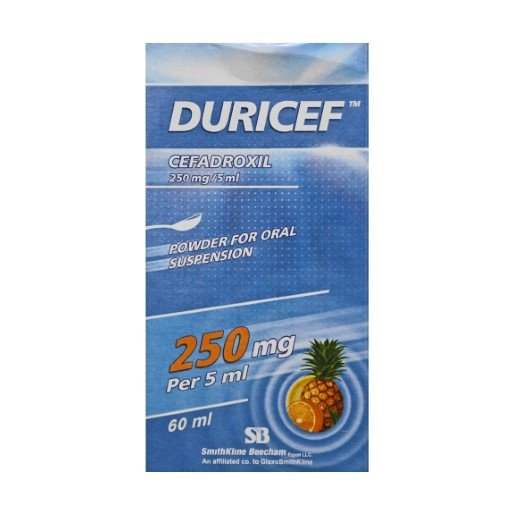
Duricef susp powder 250 mg/5 ml 60 ml
Available at Pharmaegy Pharmacy. Use as directed by your doctor.
Duricef Cefadroxil 250 mg/ 5 ml Powder for oral suspension 60 ml Composition: Cefadroxil monohydrate 250 mg/ 5 ml Description: Duricef is a semisynthetic cephalosporin antibiotic intended for oral administration. In vitro tests demonstrate that the cephalosporins are bactericidal because of their inhibition of cell-wall synthesis. Cefadroxil has been shown to be active against the following organisms: -Beta-hemolytic streptococci -Staphylococci, including penicillinase-producing strains -Streptococcus (Diplococcus) pneumoniae -Escherichia coli -Proteus mirabilis -Klebsiella species -Moraxella (Branhamella) catarrhalis •Note: Most strains of Enterococcus faecalis (formerly Streptococcus faecalis) and Enterococcus faecium (formerly Streptococcus faecium) are resistant to Duricef. It is not active against most strains of Enterobacter species, Morganella morganii (formerly Proteus morganii), and P. vulgaris. It has no activity against Pseudomonas species and Acinetobacter calcoaceticus (formerly Mima and Herellea species). Indications: Duricef is indicated for the treatment of patients with infection caused by susceptible strains of the designated organisms in the following diseases: -Urinary tract infections caused by E. coli, P. mirabilis, and Klebsiella species. -Skin and skin structure infections caused by staphylococci and/or streptococci. -Pharyngitis and/or tonsillitis caused by Streptococcus pyogenes (Group A beta-hemolytic streptococci). Dosage and administration: -Duricef acid-stable and may be administered orally without regard to meals. Administration with food may be helpful in diminishing potential gastrointestinal complaints occasionally associated with oral cephalosporin therapy. •Adults: -Urinary Tract Infections: For uncomplicated lower urinary tract infections (i.e., cystitis) the usual dosage is 1 or 2 g per day in a single (q.d.) or divided doses (b.i.d.). -For all other urinary tract infections the usual dosage is 2 g per day in divided doses (b.i.d.). -Skin and Skin Structure Infections: For skin and skin structure infections the usual dosage is l g per day in single (q.d.) or divided doses (b.i.d.). -Pharyngitis and Tonsillitis: Treatment of group A beta-hemolytic streptococcal pharyngitis and tonsillitis -1 g per day in single (g.d.) or divided doses (b.i.d.) for 10 days. •Children: -For urinary tract infections, the recommended daily dosage for children is 30 mg/kg/day in divided doses every 12 hours. -For pharyngitis, tonsillitis, and impetigo, the recommended daily dosage for children is 30 mg/kg/day in a single dose or in equally divided doses every 12 hours. for other skin and skin structure infections, the recommended daily dosage is 30 mg/kg/day in equally divided doses every 12 hours. -In the treatment of beta-hemolytic streptococcal infections, a therapeutic dosage of Duricef should be administered for at least 10 days. •Child's Weight/Dosage: 9.1 kg 1 tsp 13.6 kg 1-1/2 tsp 18.2 kg 2 tsp 22.7 kg 2-1/2 tsp 27.3 3 tsp -Renal Impairment In patients with renal impairment, the dosage of cefadroxil monohydrate should be adjusted according to creatinine clearance rates to prevent drug accumulation. The following schedule is suggested. In adults, the initial dose is 1000 mg of DURICEF and the maintenance dose (based on the creatinine clearance rate ([m/min/1.73 M]) is 500 mg at the time intervals listed below. Creatinine Clearances Dosage Interval: 0-10 mL/min 36 hours 10-25 mL/min 24 hours 25-50 mL/min 12 hours Patients with creatinine clearance rates over 50 mL/min may be treated as if they were patients having normal renal function. How to Prepere: -Suspend in a total of 67 ml of water. Tap the bottle lightly to loosen the powder. Add 67 ml of water in two portions. Shake well after each addition. Shake well before using. Side effects: -Gastrointestinal: Onset of pseudomembranous colitis symptoms may occur during or after antibiotic treatment. Dyspepsia, nausea and vomiting have been reported rarely. Diarrhea has also occurred. -Hypersensitivity: Allergies (in the form of rash, urticaria, angioedema, and pruritus) have been observed. These reactions usually subsided upon discontinuation of the drug. Anaphylaxis has also been reported. -Other: hepatic dysfunction including cholestasis and elevations in serum transaminase, genital pruritus, genital moniliasis, vaginitis, moderate transient neutropenia, fever. Agranulocytosis, thrombocytopenia, idiosyncratic hepatic failure, erythema multiforme. Toxic epidermal necrolysis, abdominal pain, superinfection, renal dysfunction, toxic nephropathy, aplastic anemia, hemolytic anemia, hemorrhage, prolonged prothrombin time, positive Coombs' test, increased BUN, increased creatinine, elevated alkaline phosphatase, elevated aspartate aminotransferase (AST), elevated alanine aminotransferase (ALT), elevated bilirubin, elevated LDH, eosinophilia, pancytopenia, neutropenia. Contraindications: -Known allergy to the cephalosporin group of antibiotics. Precautions: •Before therapy with Duricef is instituted, careful inquiry should be made to determine whether the patient has had previous hypersensitivity reactions to cefadroxil, cephalosporins, penicillins, or other drugs. •If an allergic reaction to duricef occurs, discontinue the drug. •Pseudomembranous colitis has been reported with nearly all antibacterial agents, including cefadroxil, and may range from mild to life-threatening. Therefore, it is important to consider this diagnosis in patients who present with diarrhea subsequent to the administration of antibacterial agents. Treatment with antibacterial agents alters the normal flora of the colon and may permit overgrowth of clostridia. Studies indicated that a toxin produced by Clostridium difficile is a primary cause of antibiotic-associated colitis After the diagnosis of pseudomembranous colitis has been established, therapeutic measures should be initiated. •Duricef (cefadroxil monohydrate, USP) should be used with caution in the presence of markedly impaired renal function (creatinine clearance rate of less than 50 mL/min/1.73 M´). In patients with known or suspected renal impairment, careful clinical observation and appropriate laboratory studies should be made prior to and during therapy. •Prolonged use of Duricef may result in the overgrowth of nonsusceptible organisms. Careful observation of the patient is essential. If superinfection occurs during therapy, appropriate measures should be taken. •Duricef should be prescribed with caution in individuals with a history of gastrointestinal disease, particularly colitis. •Positive direct Coombs' tests have been reported during treatment with the cephalosporin antibiotics. In hematologic studies or in transfusion cross-matching procedures when antiglobulin tests are performed on the minor side or in Coombs' testing of newborns whose mothers have received cephalosporin antibiotics before parturition, it should be recognized that a positive Coombs' test may be due to the drug. •Carcinogenesis, Mutagenesis and Impairment of Fertility: No long-term studies have been performed to determine carcinogenic potential. No genetic toxicity tests have been performed. Geriatric use: The reported clinical experience with cefadroxil has not identified differences in responses between elderly and younger patients, but greater sensitivity of some older individuals cannot be ruled out. •Renal impairment: Because elderly patients are more likely to have decreased renal function, care should be taken in dose selection, and it may be useful to monitor renal function. Pregnancy: This drug should be used during pregnancy only if clearly needed. Nursing mothers: Caution should be exercised when cefadroxil monohydrate is administered to a nursing mother. Storage: Store at a temperature 15°C– 30°C. After reconstitution, store in the refrigerator. Keep the container tightly closed. Discard unused portions after 14 days. Package: Carton box holds a bottle of 60 ml and an insert leaflet.

Duricef susp powder 250 mg/5 ml 60 ml
Description
Duricef Cefadroxil 250 mg/ 5 ml Powder for oral suspension 60 ml Composition: Cefadroxil monohydrate 250 mg/ 5 ml Description: Duricef is a semisynthetic cephalosporin antibiotic intended for oral administration. In vitro tests demonstrate that the cephalosporins are bactericidal because of their inhibition of cell-wall synthesis. Cefadroxil has been shown to be active against the following organisms: -Beta-hemolytic streptococci -Staphylococci, including penicillinase-producing strains -Streptococcus (Diplococcus) pneumoniae -Escherichia coli -Proteus mirabilis -Klebsiella species -Moraxella (Branhamella) catarrhalis •Note: Most strains of Enterococcus faecalis (formerly Streptococcus faecalis) and Enterococcus faecium (formerly Streptococcus faecium) are resistant to Duricef. It is not active against most strains of Enterobacter species, Morganella morganii (formerly Proteus morganii), and P. vulgaris. It has no activity against Pseudomonas species and Acinetobacter calcoaceticus (formerly Mima and Herellea species). Indications: Duricef is indicated for the treatment of patients with infection caused by susceptible strains of the designated organisms in the following diseases: -Urinary tract infections caused by E. coli, P. mirabilis, and Klebsiella species. -Skin and skin structure infections caused by staphylococci and/or streptococci. -Pharyngitis and/or tonsillitis caused by Streptococcus pyogenes (Group A beta-hemolytic streptococci). Dosage and administration: -Duricef acid-stable and may be administered orally without regard to meals. Administration with food may be helpful in diminishing potential gastrointestinal complaints occasionally associated with oral cephalosporin therapy. •Adults: -Urinary Tract Infections: For uncomplicated lower urinary tract infections (i.e., cystitis) the usual dosage is 1 or 2 g per day in a single (q.d.) or divided doses (b.i.d.). -For all other urinary tract infections the usual dosage is 2 g per day in divided doses (b.i.d.). -Skin and Skin Structure Infections: For skin and skin structure infections the usual dosage is l g per day in single (q.d.) or divided doses (b.i.d.). -Pharyngitis and Tonsillitis: Treatment of group A beta-hemolytic streptococcal pharyngitis and tonsillitis -1 g per day in single (g.d.) or divided doses (b.i.d.) for 10 days. •Children: -For urinary tract infections, the recommended daily dosage for children is 30 mg/kg/day in divided doses every 12 hours. -For pharyngitis, tonsillitis, and impetigo, the recommended daily dosage for children is 30 mg/kg/day in a single dose or in equally divided doses every 12 hours. for other skin and skin structure infections, the recommended daily dosage is 30 mg/kg/day in equally divided doses every 12 hours. -In the treatment of beta-hemolytic streptococcal infections, a therapeutic dosage of Duricef should be administered for at least 10 days. •Child's Weight/Dosage: 9.1 kg 1 tsp 13.6 kg 1-1/2 tsp 18.2 kg 2 tsp 22.7 kg 2-1/2 tsp 27.3 3 tsp -Renal Impairment In patients with renal impairment, the dosage of cefadroxil monohydrate should be adjusted according to creatinine clearance rates to prevent drug accumulation. The following schedule is suggested. In adults, the initial dose is 1000 mg of DURICEF and the maintenance dose (based on the creatinine clearance rate ([m/min/1.73 M]) is 500 mg at the time intervals listed below. Creatinine Clearances Dosage Interval: 0-10 mL/min 36 hours 10-25 mL/min 24 hours 25-50 mL/min 12 hours Patients with creatinine clearance rates over 50 mL/min may be treated as if they were patients having normal renal function. How to Prepere: -Suspend in a total of 67 ml of water. Tap the bottle lightly to loosen the powder. Add 67 ml of water in two portions. Shake well after each addition. Shake well before using. Side effects: -Gastrointestinal: Onset of pseudomembranous colitis symptoms may occur during or after antibiotic treatment. Dyspepsia, nausea and vomiting have been reported rarely. Diarrhea has also occurred. -Hypersensitivity: Allergies (in the form of rash, urticaria, angioedema, and pruritus) have been observed. These reactions usually subsided upon discontinuation of the drug. Anaphylaxis has also been reported. -Other: hepatic dysfunction including cholestasis and elevations in serum transaminase, genital pruritus, genital moniliasis, vaginitis, moderate transient neutropenia, fever. Agranulocytosis, thrombocytopenia, idiosyncratic hepatic failure, erythema multiforme. Toxic epidermal necrolysis, abdominal pain, superinfection, renal dysfunction, toxic nephropathy, aplastic anemia, hemolytic anemia, hemorrhage, prolonged prothrombin time, positive Coombs' test, increased BUN, increased creatinine, elevated alkaline phosphatase, elevated aspartate aminotransferase (AST), elevated alanine aminotransferase (ALT), elevated bilirubin, elevated LDH, eosinophilia, pancytopenia, neutropenia. Contraindications: -Known allergy to the cephalosporin group of antibiotics. Precautions: •Before therapy with Duricef is instituted, careful inquiry should be made to determine whether the patient has had previous hypersensitivity reactions to cefadroxil, cephalosporins, penicillins, or other drugs. •If an allergic reaction to duricef occurs, discontinue the drug. •Pseudomembranous colitis has been reported with nearly all antibacterial agents, including cefadroxil, and may range from mild to life-threatening. Therefore, it is important to consider this diagnosis in patients who present with diarrhea subsequent to the administration of antibacterial agents. Treatment with antibacterial agents alters the normal flora of the colon and may permit overgrowth of clostridia. Studies indicated that a toxin produced by Clostridium difficile is a primary cause of antibiotic-associated colitis After the diagnosis of pseudomembranous colitis has been established, therapeutic measures should be initiated. •Duricef (cefadroxil monohydrate, USP) should be used with caution in the presence of markedly impaired renal function (creatinine clearance rate of less than 50 mL/min/1.73 M´). In patients with known or suspected renal impairment, careful clinical observation and appropriate laboratory studies should be made prior to and during therapy. •Prolonged use of Duricef may result in the overgrowth of nonsusceptible organisms. Careful observation of the patient is essential. If superinfection occurs during therapy, appropriate measures should be taken. •Duricef should be prescribed with caution in individuals with a history of gastrointestinal disease, particularly colitis. •Positive direct Coombs' tests have been reported during treatment with the cephalosporin antibiotics. In hematologic studies or in transfusion cross-matching procedures when antiglobulin tests are performed on the minor side or in Coombs' testing of newborns whose mothers have received cephalosporin antibiotics before parturition, it should be recognized that a positive Coombs' test may be due to the drug. •Carcinogenesis, Mutagenesis and Impairment of Fertility: No long-term studies have been performed to determine carcinogenic potential. No genetic toxicity tests have been performed. Geriatric use: The reported clinical experience with cefadroxil has not identified differences in responses between elderly and younger patients, but greater sensitivity of some older individuals cannot be ruled out. •Renal impairment: Because elderly patients are more likely to have decreased renal function, care should be taken in dose selection, and it may be useful to monitor renal function. Pregnancy: This drug should be used during pregnancy only if clearly needed. Nursing mothers: Caution should be exercised when cefadroxil monohydrate is administered to a nursing mother. Storage: Store at a temperature 15°C– 30°C. After reconstitution, store in the refrigerator. Keep the container tightly closed. Discard unused portions after 14 days. Package: Carton box holds a bottle of 60 ml and an insert leaflet.
Highlights
-
Effective for pain relief and fever reduction..
-
Suitable for adults and children as directed..
-
Fast-acting formula with proven safety profile.
-
Available in various dosage forms and pack sizes.
Directions for use
Use as directed by your doctor.
Storage
Store in a cool, dry place away from sunlight.
Administration Instructions
Follow the prescribed method of administration as advised by your healthcare provider.
Warning
Consult your physician before use.
Precaution
Duricef susp powder 250 mg/5 ml 60 ml
-
Free Shipping
For orders from $50 -
Support 24/7
Call us any time -
100% Safety
Only secure payments -
Hot Offers
Discounts up to 90%