

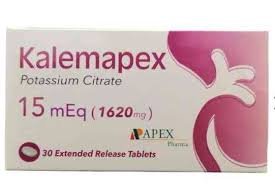
Available at Pharmaegy Pharmacy. Use as directed by your doctor.
Kalemapex 10 tablets
Ingredients:
Potassium citrate - 15 mEq (1620 mg).
Description:
Potassium citrate-based medication for correction of metabolic acidosis and prevention of kidney stones. Alkalinizes urine, increases citrate levels (inhibitor of calcium salt crystallization), and reduces risk of calcium oxalate and urate stone formation.
Indications:
-Renal tubular acidosis with calcium stones.
-Hypocitraturic calcium oxalate nephrolithiasis.
-Uric acid lithiasis (with or without calcium stones).
Dosage and Administration:
Dosage: 1 tablet (1080–1620 mg potassium citrate) 2–3 times daily with meals.
Dose adjustment: based on urinary pH (target: 6.0–7.0) and citraturia levels.
Requirements: strict low-salt diet and fluid intake ≥2 L/day.
Contraindications:
-Hyperkalemia.
-Chronic renal failure (GFR <0.7 mL/kg/min).
-GI disorders: peptic ulcer disease, intestinal obstruction.
-Use of potassium-sparing diuretics (spironolactone, triamterene).
-Active urinary tract infections.
Precautions:
-Regular monitoring of electrolytes (K⁺, Na⁺, Cl⁻, CO₂), creatinine, and CBC every 4 months.
-ECG monitoring in patients with cardiovascular diseases.
-Immediate withdrawal if hyperkalemia or GI ulcers occur.
Adverse Reactions:
-Gastrointestinal disorders (nausea, vomiting, diarrhea).
-Hyperkalemia (life-threatening!).
-Risk of intestinal ulcers/stenosis.
-Intact tablet matrices in stool.
Pregnancy and Lactation:
Pregnancy: use only if strictly necessary (no safety data).
Lactation: caution advised (potassium excreted in breast milk).
Storage:
Store at temperatures not exceeding 30°C in a dry place.
Keep out of reach of children.
Package:
Carton box containing 3 blisters (10 tablets each) + leaflet.

Kalemapex 30 tablets
Description
Kalemapex 10 tablets
Ingredients:
Potassium citrate - 15 mEq (1620 mg).
Description:
Potassium citrate-based medication for correction of metabolic acidosis and prevention of kidney stones. Alkalinizes urine, increases citrate levels (inhibitor of calcium salt crystallization), and reduces risk of calcium oxalate and urate stone formation.
Indications:
-Renal tubular acidosis with calcium stones.
-Hypocitraturic calcium oxalate nephrolithiasis.
-Uric acid lithiasis (with or without calcium stones).
Dosage and Administration:
Dosage: 1 tablet (1080–1620 mg potassium citrate) 2–3 times daily with meals.
Dose adjustment: based on urinary pH (target: 6.0–7.0) and citraturia levels.
Requirements: strict low-salt diet and fluid intake ≥2 L/day.
Contraindications:
-Hyperkalemia.
-Chronic renal failure (GFR <0.7 mL/kg/min).
-GI disorders: peptic ulcer disease, intestinal obstruction.
-Use of potassium-sparing diuretics (spironolactone, triamterene).
-Active urinary tract infections.
Precautions:
-Regular monitoring of electrolytes (K⁺, Na⁺, Cl⁻, CO₂), creatinine, and CBC every 4 months.
-ECG monitoring in patients with cardiovascular diseases.
-Immediate withdrawal if hyperkalemia or GI ulcers occur.
Adverse Reactions:
-Gastrointestinal disorders (nausea, vomiting, diarrhea).
-Hyperkalemia (life-threatening!).
-Risk of intestinal ulcers/stenosis.
-Intact tablet matrices in stool.
Pregnancy and Lactation:
Pregnancy: use only if strictly necessary (no safety data).
Lactation: caution advised (potassium excreted in breast milk).
Storage:
Store at temperatures not exceeding 30°C in a dry place.
Keep out of reach of children.
Package:
Carton box containing 3 blisters (10 tablets each) + leaflet.
Highlights
Effective for pain relief and fever reduction..
Suitable for adults and children as directed..
Fast-acting formula with proven safety profile.
Available in various dosage forms and pack sizes.
Directions for use
Use as directed by your doctor.
Storage
Store in a cool, dry place away from sunlight.
Administration Instructions
Follow the prescribed method of administration as advised by your healthcare provider.