

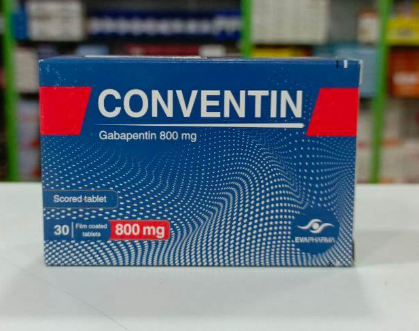
Conventin 800 mg 30 tablets
Available at Pharmaegy Pharmacy. Use as directed by your doctor.
Conventin Gabapentin 800 mg 30 Film coated tablets Composition: Each tablet contains: Active ingredient: Gabapentin 600 mg. Each Conventin 800 mg film coated tablet contains: Active ingredient: Gabapentin 800 mg. Inactive ingredients: Copovidone, Hydroxypropylcellulose, Maize Starch, Poloxamer 407, Magnesium Stearate, Hydroxypropylcel-lulose, Talc. Indications: Conventin is indicated for management of postherpetic neuraigia in adults. Adjunctive therapy in the treatment of partial onset seizures, with and without secondary generalization, in adults and pediatric patients 3 years and older with epilepsy. Dosage and Method of Administration: Dosage for Postherpetic Neuralgia: in adults with postherpetic neuralgia. Conventin may be initiated on Day 1 as a single 300 mg dose, on Day 2 as 600 mg/day (300 mg two times a day), and on Day 3 as 900 mg/day (300 mg three times a day). The dose can subsequently be titrated up as needed for pain relief to a dose of 1800 mg/day (600 mg three times a day). Efficacy was demonstrated over a range of doses from 1800 mg/day to 3600 mg/day with comparable effects across the dose range; however, the additional benefit of using doses greater than 1800 mg/day was not demonstrated. Dosage for Epilepsy with Partial Onset Seizures: Patients 12 years of age and above: the starting dose is 300 mg three times a day. The recommended maintenance dose of Conventin is 300 mg to 600 mg three times a day. Dosages up to 2400 mg/day have been well tolerated in long-term clinical studies. Doses of 3600 mg/day have also been administered to a small number of patients for a relatively short duration and have been well tolerated. Administer Conventin three times a day using 600 mg or 800 mg tablets. The maximum time between doses should not exceed 12 hours. Pediatric Patients Age 3 to 11 years: the starting dose range is 10 mg/kg/day to 15 mg/kg/day, given in three divided doses, and the recommended maintenance dose reached by upward titration over a period of approximately 3 days. The recommended maintenance dose of Conventin in patients 3 to 4 years of age is 40 mg/kg/day, given in three divided doses. The recommended maintenance dose of gabapentin in patients 5 to 11 years of age is 25 mg/kg/day to 35 mg/kg/day, given in three divided doses. Dosages up 1o 50 mg/kg/day have been well tolerated in a long-term clinical study. The maximum time interval between doses should not exceed 12 hours. For more information of dosage see insert leaflet. Contraindication: Conventin is contraindicated in patients who have demonstrated hypersensitivity to the drug or its ingredients. Precautions: -Hypersensitivity: Drug Reaction with Eosinophilia and Systemic Symptoms (DRESS), also known as multiorgan hypersensitivity, has occurred with Conventin. -Anaphylaxis and Angioedema: Conventin can cause anaphylaxis and angioedema after the first dose or at any time during treatment. -Somnolence/Sedation and Dizziness: during the controlled epilepsy trials in patients older than 12 years of age receiving doses of gabapentin up to 1800 mg daily, somnolence, dizziness, and ataxia were reported at a greater rate in patients receiving gabapentin compared to placebo. -Withdrawal Precipitated Seizure, Status Epilepticus: Antiepileptic drugs should not be abruptly discontinued because of the possibility of increasing seizure frequency. Because adequate historical data are not available, it is impossible to say whether or not treatment with gabapentin is associated with a higher or lower rate of status epilepticus than would be expected to occur in a similar population not treated with gabapentin. -Suicidal Behavior and Ideation: Antiepileptic drugs (AEDs), including gabapentin, increase the risk of suicidal thoughts or behavior in patients taking these drugs for any indication. Patients treated with any AED for any indication should be monitored for the emergence or worsening of depression, suicidal thoughts or behavior, and/or any unusual changes in mood or behavior. -Respiratory Depression: there is evidence from case reports, human studies, and animal studies associating gabapentin with serious, life-threatening, or fatal respiratory depression when coadministered with CNS depressants, including opioids, or in the setting of underlying respiratory impairment. -Neuropsychiatric Adverse Reactions (Pediatric Patients 3 to 12 Years of Age): Gabapentin use in pediatric patients with epilepsy 3 to 12 years of age is associated with the occurrence of CNS related adverse reactions. The most significant of these can be classified into the following categories: 1) emotional lability (primarily behavioral problems), 2) hostility, including aggressive behaviors, 3) thought disorder, including concentration problems and change in school performance, and 4) hyperkinesia (primarily restlessness and hyperactivity). Among the gabapentin- treated patients; most of the reactions were mild to moderate in intensity. Side Effects: Suicidal Behavior, Respiratory Depression, Neuropsychiatric Adverse Reactions (Pediatric Patients 3 to 12 Years of Age), Sudden and Unexplained Death in Patients with Epilepsy. Post-marketing Experience: the following adverse reactions have been identified during post-marketing use of gabapentin: -Hepatobiliary disorders: jaundice Investigations: elevated creatine kinase, elevated liver function tests. Metabolism and nutrition disorders: hyponatremia. Musculoskeletal and connective tissue disorder: rhabdomyolysis. -Nervous system disorders: movement disorder. Psychiatric disorders: agitation. Reproductive system and breast disorders: breast enlargement, changes in libido, ejaculation disorders and anorgasmia. -Skin and subcutaneous tissue disorders: angioedema, bullous pemphigoid, erythema multiforme, Stevens-Johnson syndrome. There are post-marketing reports of lite-threatening or fatal respiratory depression in patients taking Conventin with opioids or other CNS depressants, or in the setting of underlying respiratory impairment. Adverse reactions following the abrupt discontinuation of gabapentin have also been reported. The most frequently reported reactions were anxiety, insomnia, nausea, pain, and sweating. Pregnancy: Pregnancy Exposure Registry: there is a pregnancy exposure registry that monitors pregnancy outcomes in women exposed to antiepileptic drugs (AEDs), such as gabapentin, during pregnancy. Lactation: Gabapentin is secreted in human milk following oral administration. The effects on the breastfed infant and on milk production are unknown. The developmental and health benefits of breastfeeding should be considered along with the mother's clinical need for Conventin and any potential adverse effects on the breastfed infant from Conventin or from the underlying maternal condition. Storage Method: Store in a dry place, at a temperature not exceeding 30°C. Package: Carton box contains 3 blisters each 10 film coated tablets + insert leaflet.

Conventin 800 mg 30 tablets
Description
Conventin Gabapentin 800 mg 30 Film coated tablets Composition: Each tablet contains: Active ingredient: Gabapentin 600 mg. Each Conventin 800 mg film coated tablet contains: Active ingredient: Gabapentin 800 mg. Inactive ingredients: Copovidone, Hydroxypropylcellulose, Maize Starch, Poloxamer 407, Magnesium Stearate, Hydroxypropylcel-lulose, Talc. Indications: Conventin is indicated for management of postherpetic neuraigia in adults. Adjunctive therapy in the treatment of partial onset seizures, with and without secondary generalization, in adults and pediatric patients 3 years and older with epilepsy. Dosage and Method of Administration: Dosage for Postherpetic Neuralgia: in adults with postherpetic neuralgia. Conventin may be initiated on Day 1 as a single 300 mg dose, on Day 2 as 600 mg/day (300 mg two times a day), and on Day 3 as 900 mg/day (300 mg three times a day). The dose can subsequently be titrated up as needed for pain relief to a dose of 1800 mg/day (600 mg three times a day). Efficacy was demonstrated over a range of doses from 1800 mg/day to 3600 mg/day with comparable effects across the dose range; however, the additional benefit of using doses greater than 1800 mg/day was not demonstrated. Dosage for Epilepsy with Partial Onset Seizures: Patients 12 years of age and above: the starting dose is 300 mg three times a day. The recommended maintenance dose of Conventin is 300 mg to 600 mg three times a day. Dosages up to 2400 mg/day have been well tolerated in long-term clinical studies. Doses of 3600 mg/day have also been administered to a small number of patients for a relatively short duration and have been well tolerated. Administer Conventin three times a day using 600 mg or 800 mg tablets. The maximum time between doses should not exceed 12 hours. Pediatric Patients Age 3 to 11 years: the starting dose range is 10 mg/kg/day to 15 mg/kg/day, given in three divided doses, and the recommended maintenance dose reached by upward titration over a period of approximately 3 days. The recommended maintenance dose of Conventin in patients 3 to 4 years of age is 40 mg/kg/day, given in three divided doses. The recommended maintenance dose of gabapentin in patients 5 to 11 years of age is 25 mg/kg/day to 35 mg/kg/day, given in three divided doses. Dosages up 1o 50 mg/kg/day have been well tolerated in a long-term clinical study. The maximum time interval between doses should not exceed 12 hours. For more information of dosage see insert leaflet. Contraindication: Conventin is contraindicated in patients who have demonstrated hypersensitivity to the drug or its ingredients. Precautions: -Hypersensitivity: Drug Reaction with Eosinophilia and Systemic Symptoms (DRESS), also known as multiorgan hypersensitivity, has occurred with Conventin. -Anaphylaxis and Angioedema: Conventin can cause anaphylaxis and angioedema after the first dose or at any time during treatment. -Somnolence/Sedation and Dizziness: during the controlled epilepsy trials in patients older than 12 years of age receiving doses of gabapentin up to 1800 mg daily, somnolence, dizziness, and ataxia were reported at a greater rate in patients receiving gabapentin compared to placebo. -Withdrawal Precipitated Seizure, Status Epilepticus: Antiepileptic drugs should not be abruptly discontinued because of the possibility of increasing seizure frequency. Because adequate historical data are not available, it is impossible to say whether or not treatment with gabapentin is associated with a higher or lower rate of status epilepticus than would be expected to occur in a similar population not treated with gabapentin. -Suicidal Behavior and Ideation: Antiepileptic drugs (AEDs), including gabapentin, increase the risk of suicidal thoughts or behavior in patients taking these drugs for any indication. Patients treated with any AED for any indication should be monitored for the emergence or worsening of depression, suicidal thoughts or behavior, and/or any unusual changes in mood or behavior. -Respiratory Depression: there is evidence from case reports, human studies, and animal studies associating gabapentin with serious, life-threatening, or fatal respiratory depression when coadministered with CNS depressants, including opioids, or in the setting of underlying respiratory impairment. -Neuropsychiatric Adverse Reactions (Pediatric Patients 3 to 12 Years of Age): Gabapentin use in pediatric patients with epilepsy 3 to 12 years of age is associated with the occurrence of CNS related adverse reactions. The most significant of these can be classified into the following categories: 1) emotional lability (primarily behavioral problems), 2) hostility, including aggressive behaviors, 3) thought disorder, including concentration problems and change in school performance, and 4) hyperkinesia (primarily restlessness and hyperactivity). Among the gabapentin- treated patients; most of the reactions were mild to moderate in intensity. Side Effects: Suicidal Behavior, Respiratory Depression, Neuropsychiatric Adverse Reactions (Pediatric Patients 3 to 12 Years of Age), Sudden and Unexplained Death in Patients with Epilepsy. Post-marketing Experience: the following adverse reactions have been identified during post-marketing use of gabapentin: -Hepatobiliary disorders: jaundice Investigations: elevated creatine kinase, elevated liver function tests. Metabolism and nutrition disorders: hyponatremia. Musculoskeletal and connective tissue disorder: rhabdomyolysis. -Nervous system disorders: movement disorder. Psychiatric disorders: agitation. Reproductive system and breast disorders: breast enlargement, changes in libido, ejaculation disorders and anorgasmia. -Skin and subcutaneous tissue disorders: angioedema, bullous pemphigoid, erythema multiforme, Stevens-Johnson syndrome. There are post-marketing reports of lite-threatening or fatal respiratory depression in patients taking Conventin with opioids or other CNS depressants, or in the setting of underlying respiratory impairment. Adverse reactions following the abrupt discontinuation of gabapentin have also been reported. The most frequently reported reactions were anxiety, insomnia, nausea, pain, and sweating. Pregnancy: Pregnancy Exposure Registry: there is a pregnancy exposure registry that monitors pregnancy outcomes in women exposed to antiepileptic drugs (AEDs), such as gabapentin, during pregnancy. Lactation: Gabapentin is secreted in human milk following oral administration. The effects on the breastfed infant and on milk production are unknown. The developmental and health benefits of breastfeeding should be considered along with the mother's clinical need for Conventin and any potential adverse effects on the breastfed infant from Conventin or from the underlying maternal condition. Storage Method: Store in a dry place, at a temperature not exceeding 30°C. Package: Carton box contains 3 blisters each 10 film coated tablets + insert leaflet.
Highlights
-
.
-
.
-
-
Directions for use
Storage
Administration Instructions
Warning
Precaution
Conventin 800 mg 30 tablets
-
Free Shipping
For orders from $50 -
Support 24/7
Call us any time -
100% Safety
Only secure payments -
Hot Offers
Discounts up to 90%